
Jim Jarmusch’s 1999 film Ghost Dog: The Way of the Samurai stars Forest Whitaker as a modern hitman living by an 18th century code. Quiet, disciplined, precise. The film’s backbone is a real text, the Hagakure, compiled around 1710 by Yamamoto Tsunetomo, a retired samurai of the Nabeshima clan. Whitaker reads actual passages from it throughout the film. Edward Zwick’s The Last Samurai (2003) drew from the same well. Both films dramatise a quiet truth that has nothing to do with swords, and everything to do with craft.
The Samurai was a craftsman before he was a warrior. That part matters. Years of practice, obsessive attention to form, and a deep respect for the tools of the work. Strip away the mythology and the Way of the Samurai is a philosophy of craftsmanship, and it has useful things to say about design, brand, and the work Simon Bailey Design does every day.
The Detail Is the Work
The Hagakure has a line that stops most readers. Matters of small concern should be treated seriously. Matters of great concern should be treated lightly.
Read it twice. What it says is that the detail is where the discipline lives. The big decisions tend to take care of themselves when the small ones are right. Typography, spacing, the alignment of a button, the weight of a line. None of these are small. They are the work. A designer who treats the detail as a finishing touch rather than the point has missed the point.
Form Serves Function
The katana is one of the most refined objects ever made, and it is beautiful because it works. Every curve is a consequence of the cutting geometry. Every element of the blade has a job. Nothing is decorative.
Bauhaus arrived at the same idea six centuries later. Form follows function. Strip away the ornament and what remains is the thing itself, working. Simon Bailey Design operates on the same principle. A good logo is not a drawing, it is an identity compressed. A good website is not a gallery, it is a tool. Design that works, as the tagline goes, because the form is answering the function.
The Tool Is an Extension of the Hand
A samurai spent a lifetime with his sword. The grip was familiar. The balance was known. The relationship between the craftsman and the tool was not a detail, it was the whole thing.
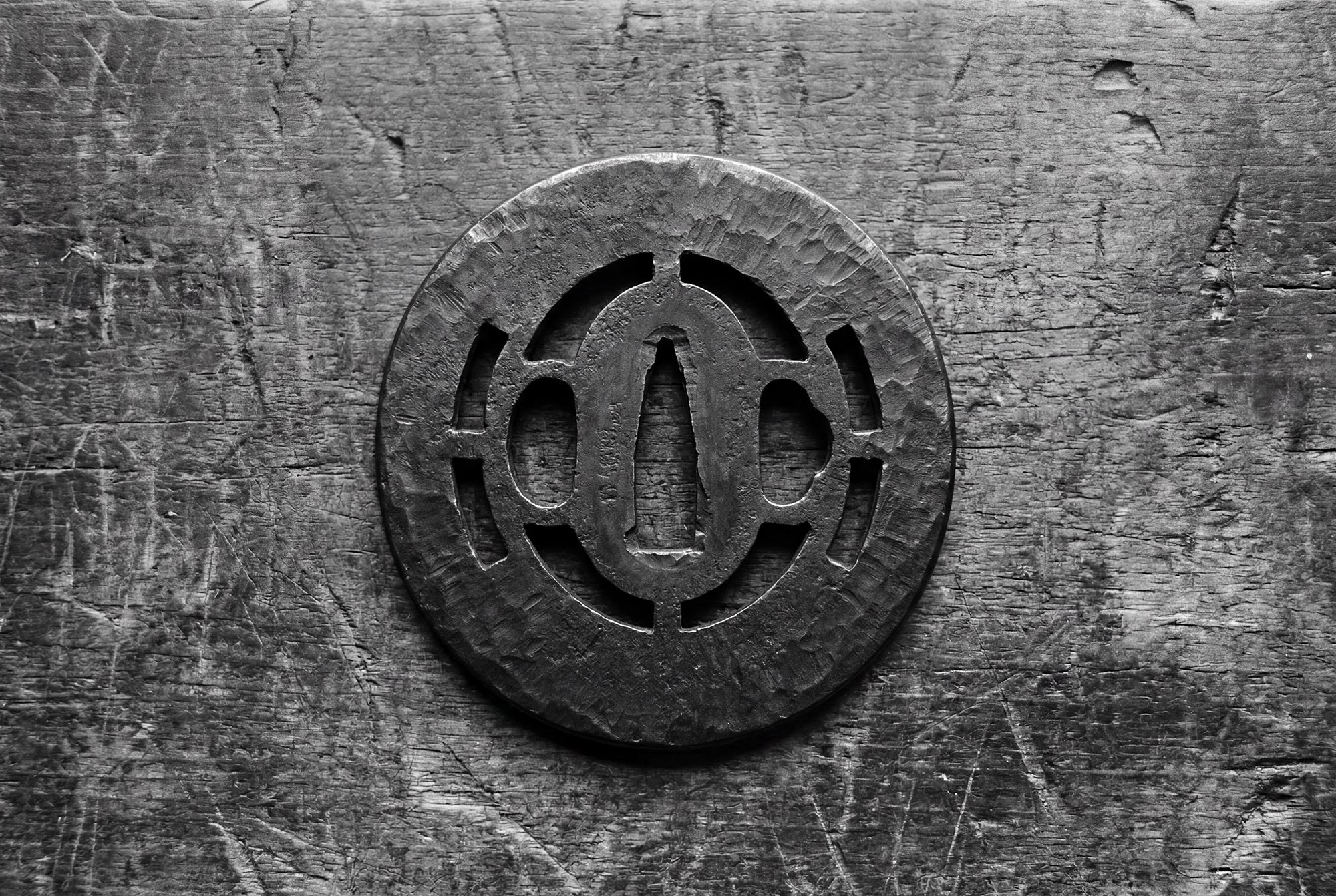
(By the way, the image above is a tsuba, the iron sword guard of a Japanese katana. The precise point where the blade meets the hand.)
The parallel to design work is direct. Over 20 years with WordPress, Adobe Creative Suite, and the quieter craft tools of the trade builds something that cannot be shortcut. The tool becomes an extension of the hand. A junior designer with the same software produces a different outcome because the relationship is newer. Nothing wrong with that, everyone starts somewhere, but experience compounds, and the compound is what clients actually pay for.
One Cut
The Hagakure is unambiguous about decisiveness. When a decision needs to be made, make it. Deliberation has its place, but endless deliberation is a failure of nerve dressed up as rigour.
Brand work, in particular, suffers when committees are allowed to wear a decision down to a nub. The cleanest logos, the sharpest taglines, the strongest websites are almost always the product of a single considered decision held firm, not a compromise between seven opinions. Sometimes the best thing a designer can do is say, this is the one, and mean it.
Refinement Over Novelty
The katana has not fundamentally changed in six hundred years. Not because swordsmiths stopped caring, but because the design reached a point where further change would make it worse. The refinement is the innovation.
This cuts against a lot of contemporary design advice, where novelty is mistaken for progress. Simon Bailey Design works the other way around. A brand that lasts is usually a brand that has been refined, not reinvented. A website that performs is usually a website whose fundamentals have been sharpened, not chased after every new trend. Craftsmanship is patient. It has to be.
The Point
The Way of the Samurai looks exotic until you notice how much of it is just discipline applied to work. Take the detail seriously. Let form serve function. Know your tools. Decide, and commit. Refine rather than reinvent.
The Last Samurai puts it another way. Katsumoto, watching the cherry blossoms: “Life in every breath, every cup of tea. The way of the warrior.” Not a bad guide for a designer either.
None of this is new. Good designers have been working this way for decades, often without knowing they were echoing a retired swordsman in 18th century Japan. Ghost Dog knew. That is why the film has aged so well.
Let’s talk about your next project. Get in touch with Simon Bailey Design to find out how good design can work for you.